An account shared with me
An Anonymous Account About Luis Felippe Mora
Hearing this account was difficult. I feel for the person who trusted me with it, and I know sharing it is not easy. I want the truth to come to light, which means taking her account seriously while being clear about what she remembers and what remains uncertain.
This page presents an anonymous contributor's recollections and my conversation with her. It distinguishes what she says she experienced directly from what she heard from others and from my own questions or interpretations. The sections labeled My update are my additional account, not part of her interview. Dates are approximate where indicated. The transcript has privacy redactions and has not been checked against an audio recording.
View the 6 supplied imagesWhy she reached out
After seeing my website, an anonymous contributor reached out to tell me about experiences she remembers involving my father, Luis Felippe Mora. I did not remember her clearly, and I said that at the beginning of our conversation. I wanted to understand her account in her own words, including what she remembered directly and what she could not place with certainty.
She explained that a childhood best friend was part of my family. Through that connection, she and her parents attended several family gatherings while she was growing up. She could not confidently identify the occasion of one early gathering. She wondered whether it might have been Easter, then said she was not sure. I am not assigning it a holiday or naming the friend or relatives involved.
What follows brings her experience into the conversation around my story. It does not turn her memories into proof of every experience I have described. Our accounts have different sources and limits. I can listen seriously to what she says happened without claiming that this interview establishes everything about my family.
What she remembers from family gatherings
I want to add context about when my father first knew her. My understanding is that Luis Felippe Mora met her in 1999, when she was six years old, through one of my cousins as a family friend. I estimate that my father was around 24 at the time. He graduated from high school in 1993, according to the family history I am providing here. These details come from me, not from the supplied interview transcript; the graduation year alone does not establish his exact age. This describes their introduction, not a claim that the conduct she later described began when she was six.
A person who contacted me as a former classmate has now sent me a yearbook excerpt. I identify the pictured student as my father and the source as the 1993 yearbook from New Milford High School in New Jersey. The excerpt, included in the image gallery below, visibly names “FELIPPE MORA,” mentions “NMHS,” and ends with “Good Luck ’93.” Those are details readers can see in the image. The supplied excerpt does not include the yearbook cover, a diploma, or a graduation record, so the full school identification and claim that he graduated remain information I am providing, rather than something this image alone establishes. It does not establish any of the reported conduct in this account.
She placed an early incident around 2006 or 2007, when she remembers being in middle school. At that time she enjoyed painting children's faces, and she said my family would invite her to do that at gatherings. She recalled a party with her parents and many other people present, where she was face painting and wearing a mini skirt.
According to her recollection, my father drew attention to her underwear, including its type and color, and repeatedly made that the subject of conversation. She described attention that felt different from how other people spoke to her. She also remembered similar interactions when she saw him on later occasions, sometimes months apart. She was describing a recurring experience, not saying that contact happened every day.
She took time to explain the difference between her reaction then and her understanding now. As a young person, she did not necessarily cry or immediately understand why the attention felt wrong. Part of her response was simply noticing that someone was paying attention to her. At the same time, she remembers something feeling unsettling because nobody else was having those conversations with her.
I do not take her clothing or her reaction as making her responsible for an adult's reported comments. Her account includes the confusion of being young and looking back later with a different understanding. Preserving that complexity matters more than creating an expectation that she should have reacted in a particular way.
The messages she remembers during school
She said the interactions also included texts from my father while she was at school. She remembered messages during a science or physics class. Later in the conversation, she identified 2009 as her freshman year of high school. That is her recollected school year, not an independently checked date for each message or for every earlier encounter.
She described the messages as flirtatious and as repeatedly returning to the subject of underwear. Those are her descriptions of their tone and subject matter. She said the contact was occasional rather than daily. She thought some messages may have followed a time when he had seen her, but did not present that timing as something she could establish consistently.
During the interview, she said the messages she remembered were on an old phone and that she no longer had access to them. Since that interview, I have supplied screenshots for this page showing a Messenger exchange with displayed dates in August and September 2007. Those images appear in the gallery below. I have not independently authenticated them or established how they relate to every text she recalled. Her original words remain unchanged in the transcript. My question about my father's age does not establish his exact age at the time.
I don't have access to those texts anymore, but, I do remember him texting me.
Kmilo Marin's wedding weekend
Another memory she described was from a relative's wedding weekend. She recalled being in a living room with a group of people before the wedding and trying to avoid my father. In her recollection, he repeatedly asked, “are you still mad about that?” She understood his manner as treating the situation as something funny and as though she should simply get over it.
She then described an interaction during the wedding event itself. She remembered ordinary activities such as dancing and picking up a bouquet. Her description moves between the ceremony and those activities, so I am not imposing an exact ceremony or reception sequence that she did not clearly give. She emphasized that she was not deliberately trying to expose her underwear.
She said my father approached her and identified what she was wearing as “hot pink cheetah underwear.” That wording comes from her recollection of the encounter, not a recording of him. She described her stomach dropping and the experience solidifying her sense that the behavior was not good. Her account of discomfort continued throughout our conversation.
I identify the event she described as Kmilo Marin's wedding, where she says my father, Luis Felippe Mora, made the sexualized comment described above. The identification of whose wedding it was comes from me, not from a name she gave in the transcript. She did not supply the wedding date. Naming the wedding does not imply that Kmilo witnessed, knew about, or participated in the reported conduct.
Separately, when I first went public with my story, I remember Kmilo Marin texting me and urging me to forgive my parents and reconnect with them. I experienced that response as dismissing what I was describing. This is my recollection of that later exchange, not part of the contributor's account of the wedding, and I am paraphrasing rather than quoting his messages.
After the contributor came forward about experiences she says occurred while she was a minor, I stopped receiving replies from him. I felt unsupported by that silence. I do not know from his lack of response what he knew beforehand, whether he expected this account to become public, or what he believes about it. Silence alone does not establish that he knew about or supported the reported conduct.
Seeing his image in 2020 and telling her mother
She recalled seeing an image of my father on Instagram during the pandemic in 2020. She said it brought on a physical reaction of discomfort and upset. She described that as the first time she told her own mother about what she remembered, and the first time she had thought about speaking about it in that way.
She described pressure from within my family to stay quiet about what she had experienced. She remembered being told not to say anything because my mother or the family would react strongly. In her account, that warning was part of why she did not speak about it at the time. This describes the pressure she says she experienced; it does not establish that every relative knew what happened or agreed that she should remain silent.
Her description connects the earlier experiences with feelings that returned years later. I am not adding a diagnosis or a clinical explanation for those reactions. I want to preserve what she actually described: seeing an image, feeling distressed, and deciding to tell her mother.
A later visit and avoiding contact
She described another occasion when a member of my family was visiting her and making stops to greet relatives. They were going to stop at my family's home. She said beforehand that she did not want to say hello to my father if he was there. When she saw him from a distance, she remembers her stomach dropping and feeling physically distressed.
She said she pretended to be having a serious phone conversation so that her eyes and attention could stay elsewhere. There was not actually anyone on the other end. While the relative got out to greet the family, she stayed occupied with that pretend conversation and did not greet anyone. She described this as a way to avoid engaging when she felt uncomfortable.
In the interview she called this visit “last year.” I do not have a confirmed interview date from which to turn that phrase into a calendar year. She placed the visit before her July 2025 outreach and connected the experience with feeling more ready to speak than she had been as a teenager. The precise date of the visit remains unresolved.
Her July 2025 message and the response she described
She said she contacted my mother, Luisa Mora, in July 2025. She described recounting the experiences in broad terms and hoping that neither I nor my siblings had been harmed. That concern was an expression of what she hoped for us, not an account of something she had seen happen to my siblings.
She told me she wanted some form of accountability, although she was not sure what response she expected. She said my mother did not answer her directly. Her understanding was that my mother gave her phone to my father, and she attributed the message that followed to him. The conversation alone does not independently establish how the phone was handled or authenticate the sender.
She summarized the reply as apologizing for his behavior, saying that he was no longer the same person he had been, and offering to meet in person to apologize. I am preserving her description without inventing the message's exact words. It would go beyond this source to call the reply a verified confession to every detail she described.
She did not want to meet. She said she did not reply and blocked contact afterward. Her decision to end that exchange is part of the account, not an invitation for anyone else to contact her or my parents.
I just wanted to have some sort of accountability
Advocacy for me and my grandmother, Vilma Galvis
I want to add a clarification about my maternal grandmother, Vilma Galvis, who is my mother's mother. The contributor's mother is good friends with Vilma. My understanding is that it was the contributor's mother who advocated for me, telling Vilma that what I described happening to me is true, even though my grandmother does not believe my account. This identification of my grandmother and clarification of their friendship come from me; Vilma is not named in the supplied interview transcript.
She also described her own mother recently speaking with unnamed members of my family about both her experiences and my situation. When I asked her to explain, she made clear that she did not know exactly what had been said or what response the relatives gave. I do not have an independently supplied account of those conversations.
Her understanding was that her mother questioned explanations that reduced my behavior to acting out or rebelling, and wanted relatives to consider whether there were experiences they were not seeing. She described her mother as upset and as trying to stand up for both of us. This is the contributor's understanding of that advocacy, not a direct statement from her mother or evidence of what every relative believed.
To be clear, I am describing the contributor's mother as the person who spoke with my grandmother, not the contributor herself. I am not treating the interview as a verbatim record of what Vilma said or as evidence of what every relative knew or believed.
What was secondhand or uncertain
Part of our conversation moved away from her own experiences to something she had heard about an alleged affair involving my father and a younger woman. She described learning about it through other people. She did not know the details, could not give a reliable date, and could not explain how they had met. This is secondhand information, separate from her account of comments and messages directed at her.
During that exchange I suggested an age for the woman and tried to place events around family milestones. Those were my suggestions, not details the contributor confirmed. When I suggested that the woman was barely eighteen or underage, she replied, “I don't want to say that for sure,” and said she only knew the woman was younger than my father. I cannot use my questions to establish either the woman's age or a date for the reported affair.
To separate my own interpretation from her account: I currently place the reported affair around or after 2011, the year my youngest sister was born. I am making that estimate from family milestones and from the contributor describing hearing about it during later high school or the beginning of college. She did not confirm 2011 or any other exact year. That estimate also does not establish how old the other woman was, when any relationship began, or that she was underage.
She also recounted information that my mother had confronted or threatened the woman and that the woman may have moved or changed jobs. She connected this story with what her own mother had said, but did not establish the precise circumstances, words, timing, or any causal connection between the reported confrontation and a move or job change. The woman is not identified here.
The conversation included interpretations of why my mother might have responded as described. Neither of us could establish her motives from this exchange. Including the transcript should not erase those limitations or make secondhand claims look like events the contributor personally witnessed.
What the Facebook discussion does and does not establish
We discussed difficulty finding my father's Facebook profile and changes in how a profile image appeared through Messenger. The contributor described mixed observations. At one point she could not find the profile; at another, opening a message still showed a photo. She also said that she had blocked him. Those details do not establish a single explanation for what we were seeing.
In the conversation I repeatedly asserted that his account had been deleted and connected that to hiding messages or being in trouble. I also made claims about additional victims, retained messages, and their possible use in court. Those were my assertions and interpretations during the call. This transcript does not independently establish any of them.
The contributor mentioned taking screenshots during the interview. I have since supplied five images for this page, including a profile view, a search screen, and a message exchange. They are shown below, but I am not claiming to have independently authenticated them. A search screen or profile image does not establish whether an account was deleted, deactivated, blocked, restricted, or unavailable for another reason. We also did not establish why.
My update: what I was told about my father's past, and what I am learning now
I grew up believing I knew the basic story of my father's life before I was born. The yearbook excerpt and information people have recently shared with me have left me questioning that understanding. Some of it appears inconsistent with what I remember being told. I feel misled, and I want to understand what actually happened. But there are still gaps, and I cannot turn those gaps into answers I do not have. This is my own context, not part of the contributor's testimony.
I remember my father, Luis Felippe Mora, telling me he came from Mexico by boat in the early 2000s. I was born in 2005. I also remember him saying he had not completed high school in Mexico and describing little formal schooling. Before people contacted me around the publication of this story, I did not know about the New Milford school history they described or the 1993 yearbook entry I now identify as his.
I also remember being told a different account involving coming into the United States from Canada, attending college for approximately two years, and being deported before completing a degree. I do not have records establishing those events, dates, or immigration circumstances. I am describing what I remember hearing, not presenting a verified immigration history. I do not know how that account fits with the Mexico story or whether they were meant to describe different journeys.
I believe I have seen a LinkedIn profile for my father listing a completed college qualification, which seems different from the account I remember hearing about leaving without a degree. I have not supplied a copy of that profile for this page, and its wording and the qualification have not been checked here. I want that discrepancy clarified. I cannot conclude from my recollection alone that a credential was fabricated, or add a college name, degree, or attendance dates I have not established.
My update: the New Jersey school information and what classmates told me
Someone who contacted me as a former classmate supplied the yearbook excerpt shown on this page. I identify it as my father's entry in the 1993 New Milford High School yearbook in New Jersey. It visibly includes “FELIPPE MORA,” “NMHS,” and “Good Luck ’93.” It does not include the book's cover or a diploma. My identification of the school and graduation year is separate from those visible details, and the excerpt does not establish his birth date or complete educational history.
People who contacted me identifying themselves as former classmates and friends told me they knew him as Felippe Mora. When I asked about Luis Felippe Mora, they said they recognized Felippe but did not recognize Luis as part of his name. That surprised me. It is what those people told me, not proof of his legal name or an explanation for how he chose to introduce himself. A name difference does not establish other abuse or other victims.
One person identifying themselves as a classmate told me my father moved from Costa Rica to New Jersey at approximately sixteen, around 1991 or 1992. This was new information to me. The age, dates, and country of origin are that person's account as relayed to me, not facts I have independently established. I am not using them to calculate a confirmed birth date.
I was also told by a person identifying themselves as a classmate that my father had lived with his mother in New Jersey. I did not remember being told about that part of his family history, and I had not met her or known about her. I am not publishing anyone's present location or contact details. This is another part of my paternal family history that I want to understand, not evidence that a relative did anything wrong.
My update: the questions these different accounts leave me with
The New Jersey school information, together with my understanding that my father first met the anonymous contributor there in 1999, has made me revisit what I thought I knew about his life before I was born. That 1999 first-meeting context comes from me. It is separate from her later descriptions of comments and messages, and I am not moving those reported incidents back to when she was six.
Where was my father actually born? How do Mexico, Canada, Costa Rica, and New Jersey fit into his life? Which parts of what I remember hearing were accurate, what did I misunderstand, and what was never explained to me? I also realize how little I know about his parents and earlier family history. These are genuine questions for me, not questions for which I already have documented answers.
I feel that I knew much less about my father's past than I believed. That leaves me wondering what else I have not been told. It does not let me conclude that a name difference conceals other abuse, that additional victims exist, or that every apparent inconsistency was a deliberate lie. Travel history and these accounts also do not establish my father's birthplace, his nationality, or my own nationality or ancestry.
I want to distinguish what I remember, what other people told me, what a supplied image actually shows, and what I still cannot resolve. I will not use gaps in one person's history as proof of another person's allegations. The contributor's account deserves to remain faithful to her words, while these questions about my family history remain clearly mine.
My update: family responses and the limits of what I know
I was told that an aunt, my mother's sister, had said to my maternal grandmother that she was not comfortable with my father being around her daughter. I did not personally witness that conversation. I tried to reach the aunt for comment and, at the time of this update, had not received a response. Her reported concern and my unanswered request are not an independently supplied account of what happened to anyone. I am keeping her daughter's identity private.
As described in the wedding section, I remember Kmilo Marin urging me to forgive my parents and reconnect when I first went public. I experienced that as dismissive. After the contributor came forward, I stopped receiving replies. His wedding is the event I identify in her account, but neither hosting that event nor not replying tells me what he witnessed, knew beforehand, or believes now.
I feel hurt and unsupported by silence or disagreement from people I hoped would hear me. I cannot turn that feeling into a finding that those relatives knew about abuse, supported it, or agreed on a response. I am not naming children or publishing a list of relatives to encourage readers to pressure them.
My update: what I remember being told about my birth
I remember my parents telling me they experienced a pregnancy loss before I was born and that the pregnancy with me was unplanned. I was born in 2005, and they later had my two younger sisters. Those are things I remember being told about my own family, not medical details established by records on this page. I am not using them to infer my parents' motives or to assign dates to the contributor's experiences.
My update: concern for my sisters and reporting
I am worried about my two younger sisters. I reached out to my youngest sister and did not receive a response, which felt unusual to me. That increased my concern, but a missed reply does not establish that she has been harmed. I am not publishing either sister's name or private contact details.
I called the West Milford Police Department and, in my account of that call, they would not take my report over the phone. I found that frustrating while trying to express my concerns. I am describing my experience, not claiming that it establishes anyone's motives or an investigative outcome.
My latest understanding is that the anonymous contributor has filed a report with local police. I have not published a copy or a confirmed filing date here. I want the information handled through the appropriate reporting process. A report is not a finding that the events described have been established.
I feel hurt by the limited support I have received from relatives. At the time of this update, I count two family members as having reached out in support. I am keeping children's identities and responses private. I cannot infer what other relatives knew or supported simply because they have not replied or have disagreed with me.
I am concerned that this website may be removed, but I do not have a confirmed removal date to publish. I want to tell my story while remaining clear about what I remember, what I have been told, and what remains unresolved. This is not a request for readers to contact, confront, or harass anyone involved.
Her anonymity and the chance to be heard
At the end of the conversation she asked me to protect other people's identities and said she did not want her own name published at this point. She asked to see the material before it went live, and I agreed. She has since reviewed and approved publication of this anonymous account and redacted transcript.
The closing discussion included offers of support, travel arrangements, accommodation, and the possibility of meeting. Those remarks remain in the transcript where appropriate, but they do not add evidence of the reported conduct. They were part of how two people ended a difficult conversation.
Being able to speak and be heard matters to me. So does keeping an account faithful to what the person actually said, rather than using it to claim more than it can establish. This submission is not automatically verified evidence, and sharing it is not a request to identify the contributor, approach relatives, or confront anyone. I want to make room for her voice without taking away her control over how it is shared.
Material supplied by Lucas
Images supplied with this account
These 6 images were supplied after the interview. The images include a cropped screenshot identified in its caption, with one unrelated name permanently redacted in the two images where it appears. The screenshots have not been independently authenticated. Open any image at full size to read its details.
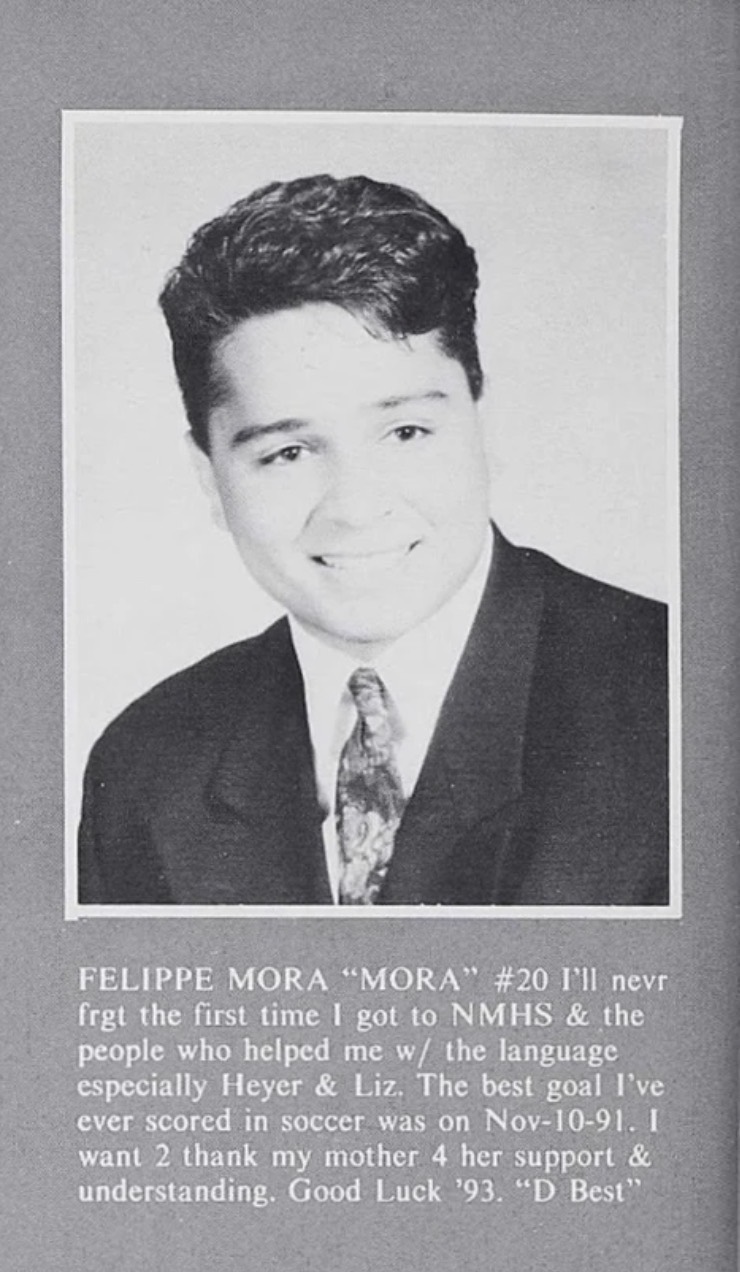
Yearbook excerpt supplied by a former classmate
I received this image from someone who contacted me as a former classmate. I identify it as my father's entry in the 1993 New Milford High School yearbook in New Jersey. The visible name, NMHS reference, and ’93 wording are reproduced here. The excerpt alone does not establish graduation or independently confirm the full school name. Image pixels are unchanged; embedded metadata has been removed.
Open image 1 at full sizeText visible in this image
Line breaks are normalized. Any bracketed name marker is an editorial redaction, not original text.
Selected visible text: FELIPPE MORA
I got to NMHS
Good Luck ’93.

Portrait supplied with the account
I supplied this portrait alongside the screenshots. A portrait alone does not establish the events described in the account.
Open image 2 at full size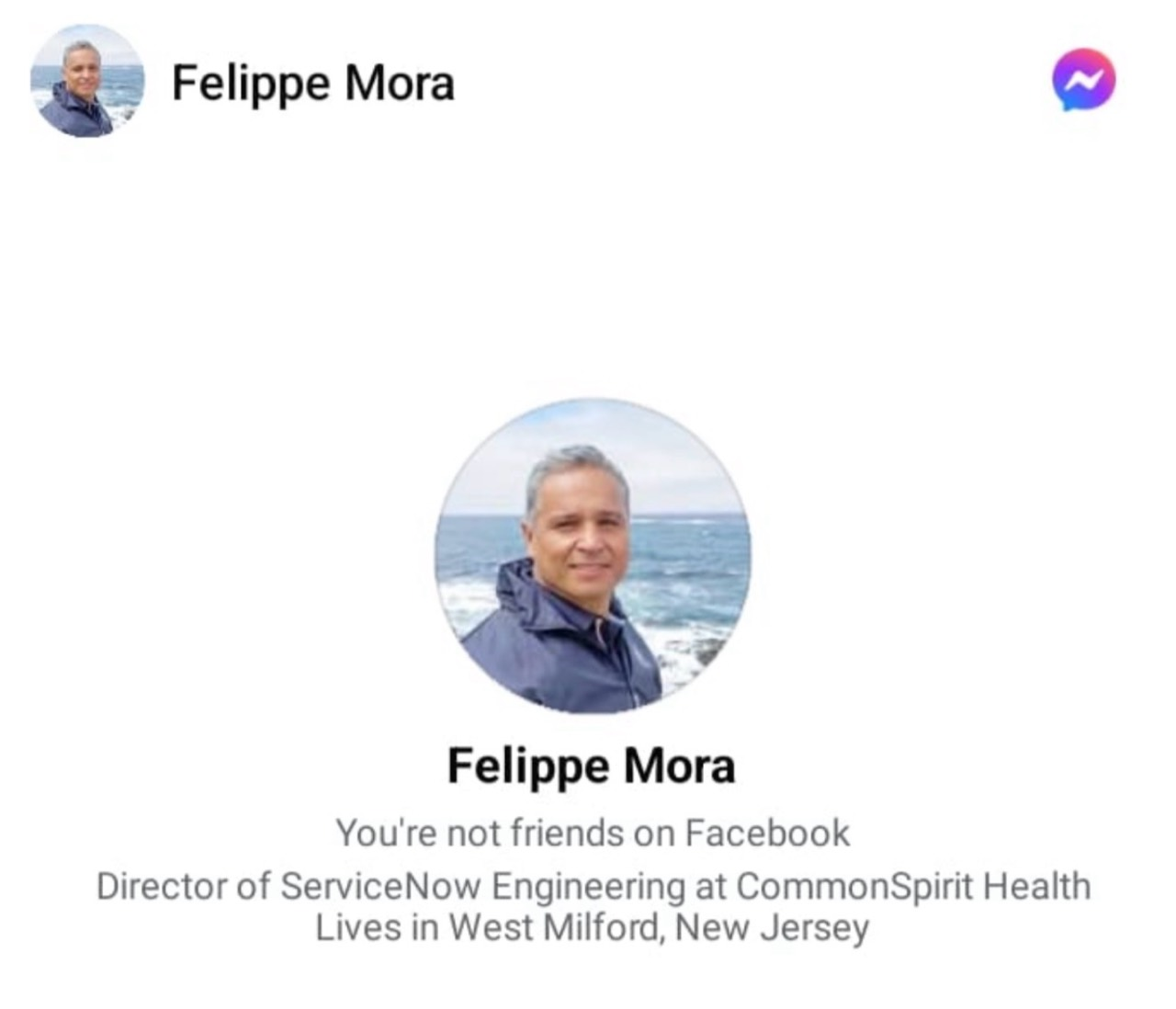
Messenger profile view
The supplied screen displays the name Felippe Mora and profile information. It is not independent verification of identity, employment, or the reported conduct. The employer displayed is not alleged to have participated in these events.
Open image 3 at full size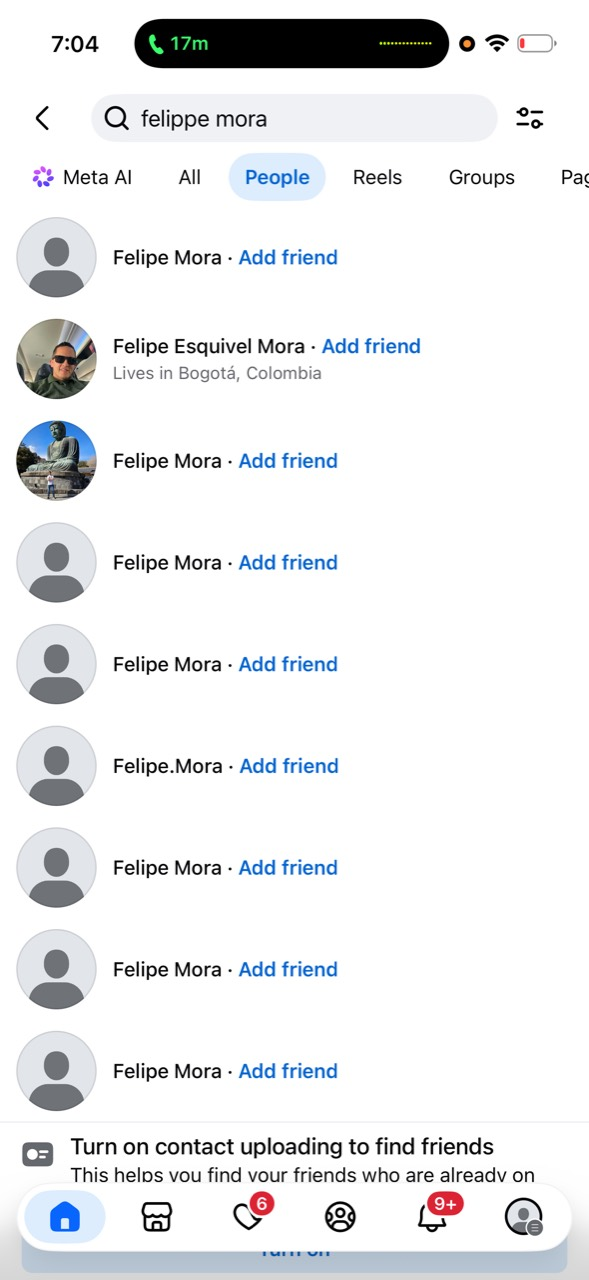
Facebook search screen
This supplied search screen relates to the profile discussion in the interview. The other results are not identified as people involved in this account. Search results do not establish account deletion or anyone's reason for an account being unavailable.
Open image 4 at full size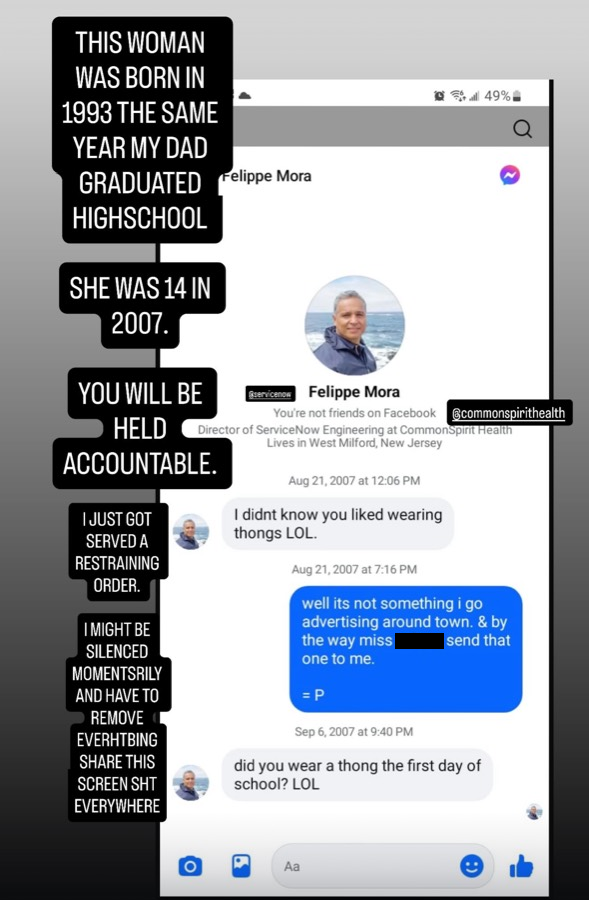
The exchange with accompanying commentary
This supplied screenshot has been cropped to remove the surrounding social media header and controls. The message content, existing name redaction, and overlaid commentary are unchanged within the crop. The age, school-year, and legal statements are author commentary, not independently established findings. The messages are also shown separately below.
Open image 5 at full size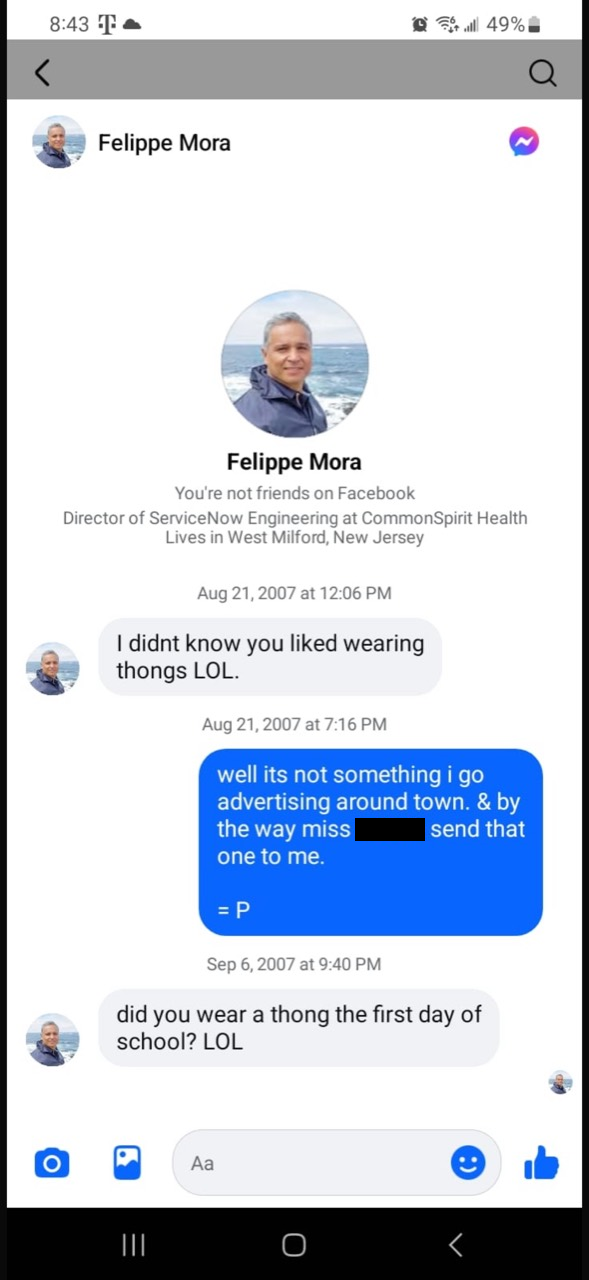
The supplied message exchange
The dates below are labels visible in the supplied screenshot, not independently verified dates. The image is not an authenticated message export. Only an unrelated name has been permanently redacted; the remaining image content is preserved.
Open image 6 at full sizeText visible in this image
Line breaks are normalized. Any bracketed name marker is an editorial redaction, not original text.
Aug 21, 2007 at 12:06 PM: I didnt know you liked wearing thongs LOL.
Aug 21, 2007 at 7:16 PM: well its not something i go advertising around town. & by the way miss [name redacted] send that one to me. = P
Sep 6, 2007 at 9:40 PM: did you wear a thong the first day of school? LOL
Recollections and unresolved dates
Chronology
Dates reflect the contributor's account or Lucas's separately identified context. A stated date is not documentary verification, and undated events are not assigned a year.
1999
Author-reported year; father's age approximateMy understanding is that my father met her through one of my cousins as a family friend when she was six. I estimate that he was around 24. This identifies when they met, not when the later reported conduct began.
Around 2006 or 2007
Approximate recollectionShe places an early face-painting gathering in her middle school years and recalls comments about her underwear.
Wedding weekend, date not supplied
Date unknownShe recalls avoiding my father before a wedding and another comment during the wedding event. I identify it as Kmilo Marin's wedding. Its date and position among the school-year memories are not settled.
Freshman year, identified as 2009
Contributor-reported yearShe recalls occasional texts during school. This does not date every reported message or earlier encounter.
During 2020
Contributor-reported yearShe recalls seeing his image on Instagram, experiencing distress, and telling her mother for the first time.
Later family visit, exact date unresolved
Relative date onlyShe described the visit as last year during the interview and placed it before the July 2025 outreach. The interview date is not confirmed.
July 2025
Contributor-reported monthShe says she contacted my mother, received a reply she attributed to my father, declined further contact, and blocked them.
Recent family conversations and this interview
Dates not suppliedShe described her understanding of her mother's conversations with relatives and requested anonymity and review before publication.
About this account
A note on accuracy
The contributor's account uses a supplied transcription, not an audio-checked transcript or an independently investigated account. She reviewed and approved its anonymous publication. The sections labeled My update were added by me and are not statements from her interview or claims she has independently endorsed.
My added family-history context separates childhood recollections from information supplied by people identifying themselves as former classmates. The Mexico, Canada, college, deportation, Costa Rica, and paternal-family accounts have not been independently established. No LinkedIn copy, education records, immigration records, or birth records have been supplied for those assertions. The reported conversation between an aunt and my grandmother was not one I personally witnessed. My recollection of what my parents told me about my birth is not a medical finding.
Dates in the chronology reflect the contributor's recollections or my separately identified context. I supplied the 1999 introduction, her age of six, my father's approximate age of 24, and his high school graduation year of 1993. These are not independently verified dates or ages. A stated year or month is not documentary verification. No interview date, exact wedding date, or exact date for the later family visit has been established.
The interview describes early messages from memory. I subsequently supplied five images, including screenshots with displayed message dates in 2007, and later added a yearbook excerpt received from someone who contacted me as a former classmate. The excerpt displays the name Felippe Mora, NMHS, and ’93; my identification of the school and graduation year is separate from what the cropped image establishes. The supplied materials have not been independently authenticated, and the displayed dates do not resolve all school-year recollections. The reply described from July 2025 remains her summary of a message she attributed to my father; these images do not show that reply. No audio recording has been reviewed for this page.
The separate affair discussion is secondhand. The other woman's age, the event date, any causal relationship with a move or job change, and the reasons for others' conduct are not established.
The Facebook discussion does not establish account deletion, its cause, message retention, additional victims, or future court use. My statements in that exchange are not independent findings.
The transcript preserves uncertain or apparently misrecognized wording for review instead of silently correcting it. Its privacy markers are editorial replacements, not words spoken in the interview.
Names alone are not the only identifying details. Family connections, school years, and the wedding description can indirectly identify a person even when names are removed. The identification of my maternal grandmother, Vilma Galvis, her friendship with the contributor's mother, and that mother's advocacy for me are my clarification. The supplied transcript describes the contributor's mother speaking with relatives but does not name Vilma.
The supplied conversation
Transcript with privacy redactions
This preserves the supplied words and turn order, with neutral speaker labels and bracketed privacy replacements. It has not been compared to audio. The interviewer's guesses and assertions are not independent evidence. The contributor asked for anonymity and prepublication review near the end.
Bracketed privacy markers are editorial replacements, not spoken words. Interruptions, uncertain wording, and apparent transcription errors remain visible. This text has not been checked against an audio recording.
Interviewer
Alright, go for it. So what kind of happened with my father? I know you saw my website and you reached out. Um, I don't really recall you too much, but I'm happy you reached out, so can you explain to me what happened with my father and and just the whole situation there?
Anonymous contributor
Yeah, so. Um, I have a childhood best friend. Um, who, is one of your family members, and growing up, we would go to a lot of, We would go to several of your family gatherings. Um, I, Honestly, it was like maybe Easter or,
Interviewer
I can't
Anonymous contributor
I'm not even
Interviewer
even.
Anonymous contributor
sure, I, But anyway, there was face painting involved, and, Um, I don't know, so the time of my life where I liked to do face painting for kids, so. Your family would have me over, along with my parents, there's a lot of other people around. And I remember this one time, this family party, I was face painting and I was wearing a mini skirt. Um, And your dad would like, kind of bring a lot of attention to this fact, and love to point out like the type of underwear I was wearing, the color I was wearing, just like the whole conversation had to do around my underwear. Um, this was like in 2006, 2007. So, I was like in middle school. I was like, yeah, I was in middle school, and At this time, when you're this young, you know, really understand how this attention is bad. So like, I wasn't necessarily like crying or anything when he said that, it was like, A young girl that was like, oh, attention, but like, you look back and it's like, ew, you know? But there's still something unsettling about it because like no one else was having these conversations with me. Um, and so he just like always loved to point that out. And then he would text me about it. I don't have those texts anymore. It was an old phone, but sometimes you would text me about it. And then, Every few months where I would see him. I think he was like the similar situation. Um, another memorable moment, I remember, was that one of your family member's wedding. Um I remember seeing him. Like I walked into the room and I saw him. We were like in a living room, a bunch of people. This was before, this is the wedding weekend, pre-wedding festivities. And I remember trying to avoid him and he just looked at me and he was like, are you still mad about that? And he kept saying that, like are you still mad about that? Like get over it kind of thing. And he thought it was really funny. Like kind of a joke about it. And I just tried to avoid him and during the actual wedding ceremony. I. was at a wedding, dancing, you know, I don't know, picking up the bouquet, like, I wasn't doing anything. I wasn't doing gymnastics, like, I wasn't doing anything purposely to show my underwear off, but nonetheless, he came up to me and he decided to tell me that I was wearing hot pink cheetah underwear. And I feel like at that moment, my stomach dropped and I was like, oh shit, like, in that moment, it came kind of solidified. Um, this behavior was not good and it made him feel uncomfortable. Um. Yeah, and it was just kind of like, Just icky behavior. Um, And. I think. His. His image came to me again or his, the idea of him came to me again. In during the pandemic in 2020. Um, can you still
Interviewer
Yeah,
Anonymous contributor
talk?
Interviewer
no, you're good. It just it makes a noise every so often.
Anonymous contributor
Okay. Um. I don't remember, but like his image popped up on Instagram. And like, I had a very, like a physical reaction. Of just like discomfort and obviously being upset. Um, and that was the 1st time I told my mom about it. Because of that was just coming up for me and that was the 1st time that I had thought about even saying something. Um. And by the way, back then. Like when all those things happened, like, one of your family members told me not to say anything because, Specifically because they would say your mom would blow up or your mom. Or your family would make a big deal of it kind of thing. And so for that reason, I wasn't to say anything. So 2020 comes and, you know, it kind of pops into my head again. And then last year, one of your family members came to visit me. And they were making their rounds of saying hi to their family members. And We were going to stop by. To your family house. And I was like, if that man is there, just know that I'm not going to say hi. And I had to try to figure out how to best do that since I was like in person driving. I saw him from afar, and my stomach dropped, and I was like, physically freaking out, you know? Um. Yeah, and I just was on the phone pretending to. Pretending to have a serious conversation with someone. But really, I was talking to no one, and it was just so my eyes and my attention could be directed, not at them, so I didn't say hi to anyone that day. Your cousin, your family member just left the car, said hi. To them and was wondering why I was being a weirdo. Having a conversation with no one, but they didn't know that. I would kind of pretend to, you know, be like, uh-huh, yeah, you know. Um. And yes, I was left with that kind of uneasiness, um. And also triggered in me to say, I really want to say something though, like. Like I have. I'm I'm much more vocal now than I would have been, you know, when I was a teenager, so. I just like ignited that fire in me and I was like, I need to say something. So that's when I messaged your mom in July 2025. And I message her, kind of recounting the details, vaguely of what happened and just letting her know that's her husband has these tendencies and like hoping that your sisters were never harmed and or you. Um, and that, I don't know. I don't know what I thought would happen. I just wanted to have some sort of accountability, but, um, she did not respond. Instead, she gave her phone. To your dad and then your dad responded and left a message that was pretty much apologizing for his behavior, saying that he wasn't the same person he was back then. And offered to meet in person to say sorry, which I thought was ridiculous, because why would you want to confront? Someone who did you harm like that? I was like, no, thank you, but I didn't respond. I just blocked them and. Um. And um, That was that with that communication. Um, my mom did. Try to have a conversation with some of your family members, not your parents, but they did try to have conversations and kind of stand up for you and for me.
Interviewer
Like recently,
Anonymous contributor
Um.
Interviewer
you mean? Or what do you mean? Like, like recently they started doing
Anonymous contributor
Yeah, in the
Interviewer
that?
Anonymous contributor
last, yeah, actually. Yeah, yeah, recently.
Interviewer
Can you explain that a little bit?
Anonymous contributor
Yeah, yeah, recently. Um, Yeah, I think maybe because you came up in conversation, and I don't know what exactly was said. It was like, maybe they were worried about you, or they, like, they had said that they were in contact with you, but you weren't in contact with your family. And then I think my mom just like raised the point of like, X, Y, Z happened to [contributor's name redacted], like, who's to put it past that this also happened to you and that, you know, this is why you were, you know, in their words like lashing out or acting up or rebelling, whatever in their words. Um, You know, and that there was something else that they weren't seeing or they weren't paying attention to and. And I don't even know if they, I don't know what their answer was. I just know that my mom was heated because she was like, If he's capable of doing this, then like, who's to put it past the, that it's like, not entirely, you know, what they think is your fault or whatever. Um, So.
Interviewer
Yeah um.
Anonymous contributor
Um, yeah, I don't know if you have any questions. I think there was other, like I mentioned, there was other texting in between.
Interviewer
Can you, yeah, can you
Anonymous contributor
Of
Interviewer
describe
Anonymous contributor
your father
Interviewer
briefly,
Anonymous contributor
texting me.
Interviewer
like the other texts, like the, the other interactions, because at this point, you were still like what middle school, underage still, and your, my dad was in his 30s texting you? Could you describe what happened in those conversations and like how that went?
Anonymous contributor
Um. Your dad, I remember, would text me doing like science class. He would text me during my 1stman physics class, and 1st of all, he was texting me during school. Second, it would just be, I think it was like the same type of conversations, just like, being very flirtatious, like, wanting to always talk about the underwear, like, Just very odd. Um, I don't have access to those texts anymore, but, I do remember him texting me. It wasn't an everyday thing. It was just a never so often, but maybe like right after he had seen me or something, um, but always very flirtatious. And, I mean, I was a freshman in high school in,
Interviewer
So when when
Anonymous contributor
2009.
Interviewer
I was 3
Anonymous contributor
So.
Interviewer
years old, essentially, and he just had me, his 1st child, I was 3 years old, he was with my mom and he was doing that to you. That is just, that is insane to me.
Anonymous contributor
Yeah, and I do know that. I thought this was common knowledge, but I do know that he had an affair.
Interviewer
Yeah,
Anonymous contributor
Um,
Interviewer
can you go into that a little bit? Because I did not know any of this.
Anonymous contributor
I don't know what I guess they didn't tell you, and I don't know if your sisters know, but, um, yeah, your father had an affair with a younger woman. Um, I don't have the details, but,
Interviewer
You
Anonymous contributor
um,
Interviewer
remember
Anonymous contributor
this was
Interviewer
what year
Anonymous contributor
like,
Interviewer
it was?
Anonymous contributor
This was a long
Interviewer
Like,
Anonymous contributor
time ago. I
Interviewer
Do
Anonymous contributor
I can't say for sure.
Interviewer
you know if, uh, was I born? Was [sibling's name redacted]
Anonymous contributor
Like
Interviewer
born?
Anonymous contributor
over 5 years ago. No, you're probably born. It was probably like over 5
Interviewer
Was
Anonymous contributor
years ago or
Interviewer
[sibling's name redacted]
Anonymous contributor
something.
Interviewer
born?
Anonymous contributor
I don't know.
Interviewer
Was it was
Anonymous contributor
[sibling's name redacted]
Interviewer
it
Anonymous contributor
is
Interviewer
was
Anonymous contributor
how old?
Interviewer
it after [sibling's birth year redacted]?
Anonymous contributor
I I couldn't, I couldn't say for sure, but.
Interviewer
Was it did it happen
Anonymous contributor
I
Interviewer
like
Anonymous contributor
couldn't say
Interviewer
when
Anonymous contributor
for sure.
Interviewer
you were later on in high school or like after out of high school or when you were still younger in high school?
Anonymous contributor
Uh, I feel like... Probably late, like later high school slash college. I mean, this was like,
Interviewer
So this
Anonymous contributor
through
Interviewer
modern,
Anonymous contributor
the grapevine.
Interviewer
This was probably, this probably happened not long in [sibling's birth year redacted] after my 3rd little sister was born. Or not 3rd little sister,
Anonymous contributor
Yeah,
Interviewer
my
Anonymous contributor
yeah.
Interviewer
2nd little sister, but the 3rd family member. This probably didn't happen much longer after [sibling's name redacted] was born in [sibling's birth year redacted] that he had an affair with someone, you said barely 18 or maybe under age. And this was common knowledge and nothing was ever said
Anonymous contributor
I,
Interviewer
about it.
Anonymous contributor
I don't, so I, I don't want to say that for sure. I don't, I just know that they were younger than he was. And I know that your mom went to his house, went to her house, and yelled at her and said, you're not going to break up my marriage and kind of threatened her or something. I forgot if that's my mom, but she like threatened her and was like, Never talked to my husband again or something. And she like moved. Or like, yeah, your mom did something that caused her to like change jobs or move out of the area
Interviewer
Wait,
Anonymous contributor
or something.
Interviewer
uh, cause who
Anonymous contributor
It was kind of
Interviewer
to,
Anonymous contributor
insane.
Interviewer
who to do that?
Anonymous contributor
The, The girl.
Interviewer
Just say that one more time.
Anonymous contributor
Your mom, your mom, your mom threatened,
Interviewer
The
Anonymous contributor
the
Interviewer
girl that
Anonymous contributor
person
Interviewer
my dad
Anonymous contributor
who was
Interviewer
cheated
Anonymous contributor
having
Interviewer
on him
Anonymous contributor
it.
Interviewer
with or that she cheated with, right?
Anonymous contributor
Yeah. Yeah, yeah.
Interviewer
Do you know like how he knew this girl? Like was he messaging them through Facebook or do you know?
Anonymous contributor
I I couldn't, I don't know those details.
Interviewer
Okay.
Anonymous contributor
I only, I only know that. Like, and I know this because in response to my mom hearing about my story, she was like, well, I'm not surprised about [mother's name redacted]'s behavior because When [father's name redacted] was cheating on her. She didn't really hold him accountable.
Interviewer
So
Anonymous contributor
I
Interviewer
she,
Anonymous contributor
mean, she might have in
Interviewer
she
Anonymous contributor
her
Interviewer
just
Anonymous contributor
own
Interviewer
didn't
Anonymous contributor
way,
Interviewer
care that he
Anonymous contributor
but
Interviewer
was cheating
Anonymous contributor
she just
Interviewer
pretty
Anonymous contributor
like
Interviewer
much.
Anonymous contributor
yelled at the girl. Oh yeah, she knows. She just like had, I don't know, maybe your mom just like idolized. always having a partner and, you know, kind of always, by always meaning like looking the other way, even with, and there was horrible things. So.
Interviewer
I'm sorry you have to deal with any of this. Um, No,
Anonymous contributor
Oh, I didn't have to do it. I mean, that was
Interviewer
no,
Anonymous contributor
just
Interviewer
no,
Anonymous contributor
something
Interviewer
no.
Anonymous contributor
I
Interviewer
I'm just talking about in general
Anonymous contributor
I
Interviewer
with
Anonymous contributor
know.
Interviewer
everything else that you talk to me about just now. Um,
Anonymous contributor
Oh, yeah.
Interviewer
like.
Anonymous contributor
Yeah, just, it's just, unfortunate that, I mean, I hope no one else had to deal with that, but I feel
Interviewer
So,
Anonymous contributor
like that's probably
Interviewer
can
Anonymous contributor
not
Interviewer
you,
Anonymous contributor
true.
Interviewer
can
Anonymous contributor
There's
Interviewer
you,
Anonymous contributor
probably other people.
Interviewer
there definitely is way more victims, and I actually looked, looked him up on Facebook not too long ago, and he completely deleted all of his Facebook, and it was there yesterday. It's
Anonymous contributor
Mhm.
Interviewer
it's all gone. He thinks it's going to get rid of the messages, but he's still going to be there when it's brought up in court, you know?
Anonymous contributor
Yeah, all this interesting, because I... Well, I guess Facebook keeps his profile. I'm not
Interviewer
No,
Anonymous contributor
sure, but
Interviewer
they
Anonymous contributor
I,
Interviewer
have
Anonymous contributor
there
Interviewer
all those
Anonymous contributor
was,
Interviewer
messages that's
Anonymous contributor
I...
Interviewer
all saved somewhere.
Anonymous contributor
Yeah, yes, I saved, yeah, because I screenshot it this
Interviewer
Yeah.
Anonymous contributor
morning.
Interviewer
And now I bet if you try to go back to that chat, it won't be there or maybe it said that his profile is gone or something. If you have a screenshot of that, that would be more proof that he deluded his account too.
Anonymous contributor
I, but I looked it up. I can try to look it up now, but I looked at it this morning and it was
Interviewer
Look,
Anonymous contributor
there, but
Interviewer
look it up again,
Anonymous contributor
I don't
Interviewer
see
Anonymous contributor
know
Interviewer
if it's
Anonymous contributor
if that
Interviewer
there still, or
Anonymous contributor
was.
Interviewer
maybe he just blocked me, but just look it up and see if it's there.
Anonymous contributor
Oh yeah, he might have blocked you. Let me see. I mean, he definitely fucked you probably. So I can look up his profile. I have to like.
Interviewer
It doesn't come up anymore?
Anonymous contributor
Hmm. I guess not.
Interviewer
Yeah, he deleted his whole account, like right after I posted that.
Anonymous contributor
Yeah.
Interviewer
He knows he's he's in trouble now. But could you, uh, also, uh, re-explain to me what you said earlier about how, what was I about to ask you? Um,
Anonymous contributor
Yeah, it doesn't come
Interviewer
Yeah,
Anonymous contributor
up.
Interviewer
no.
Anonymous contributor
It does not come up. Let me see if maybe on my phone,
Interviewer
If
Anonymous contributor
but I don't think so.
Interviewer
you maybe could go to the, your messages, like, I guess Messenger, and go to the search bar and look for that, those that, like exactly what you said or what he said specifically, and it might bring up the result of the chat, but it might show that his account is just deleted.
Anonymous contributor
What's his, what's his name is with 2
Interviewer
Yeah,
Anonymous contributor
Ps?
Interviewer
[father's name spelling redacted]. But it's not going to come up if you deleted his account. But if you might maybe like look up the message that was said in that screenshot in your messages, it might come up with the chat and the chat.
Anonymous contributor
Yeah, yeah, yeah, I see, I
Interviewer
Is
Anonymous contributor
see, I see.
Interviewer
the chat showing there, but his account is gone? Send
Anonymous contributor
His account is gone, yeah.
Interviewer
me
Anonymous contributor
But
Interviewer
that screenshot.
Anonymous contributor
when I,
Interviewer
Send me that screenshot.
Anonymous contributor
No, no, but when I click into the message, It, it shows his profile with his photo.
Interviewer
Oh, but if you click on the photo, the account was gone.
Anonymous contributor
Um.
Interviewer
Like if you,
Anonymous contributor
If I
Interviewer
like
Anonymous contributor
click the photo,
Interviewer
if
Anonymous contributor
the,
Interviewer
you try to go
Anonymous contributor
the.
Interviewer
to his profile from the from the messages.
Anonymous contributor
Well, just like, I don't have Facebook online. Um, I also blocked him.
Interviewer
All right, that's fine. I mean, it's whatever. He deleted his account, so we already know that. But.
Anonymous contributor
Yeah. Well, now it's showing that he has um, A gray.
Interviewer
A great,
Anonymous contributor
Now it's
Interviewer
great, great,
Anonymous contributor
a great
Interviewer
great. That's
Anonymous contributor
profile.
Interviewer
what it
Anonymous contributor
Yeah.
Interviewer
means when his account is deleted. screenshot that and send it to me. Like the whole DM chat with his profile picture blocked out and everything.
Anonymous contributor
Yeah.
Interviewer
Send that to me because that's that's proof right there that he deleted his account.
Anonymous contributor
Uh, uh. Yeah. I don't know if it's helpful because I was like, Oh, will I screenshot that? Doesn't show. The screenshot that this this morning. For my dad, I was talking to him about it, but, um, Anyway, I don't know if it shows like the. Look it up, the screenshot date, you know.
Interviewer
Yeah, no I see it. All right,
Anonymous contributor
Um.
Interviewer
do you have anything else you want to go further into detail about on this topic?
Anonymous contributor
Um, I don't think I have anything else. I mean, if you have any follow-up questions.
Interviewer
I definitely will when I start writing everything, but for now, I think I have like a good idea of everything that happened, and I'm truly sorry that you have to go through any of that.
Anonymous contributor
Um, thank you. I think. Yeah, also try to protect your other families. Um, names and stuff, so that's why I was trying to be vague.
Interviewer
No,
Anonymous contributor
With who is who?
Interviewer
I won't, I won't be specific with names and stuff like that. except my dad. That's
Anonymous contributor
Okay.
Interviewer
the only name that's really going to be like on there. And
Anonymous contributor
Yeah, yeah.
Interviewer
and you don't want your name on there, you said?
Anonymous contributor
Um.
Interviewer
You always change it in the future if you change your mind.
Anonymous contributor
Yeah. Um. Yeah, not right now. I guess send it to me before it's live or
Interviewer
All
Anonymous contributor
whatever.
Interviewer
right, I will.
Anonymous contributor
Um.
Interviewer
All
Anonymous contributor
Yeah.
Interviewer
right, thank you for your time and sharing your story and I'm here for you if you ever need to talk or anything. All right? I don't really,
Anonymous contributor
Okay.
Interviewer
I don't really, I don't really ever really remember you to be honest, but I'm, I'm,
Anonymous contributor
I
Interviewer
I'm,
Anonymous contributor
know, it's okay. You're very young.
Interviewer
I'm here for you if you're any talk, all right?
Anonymous contributor
Thank you. Yeah, same here. Let me know.
Interviewer
All right.
Anonymous contributor
If you, for some reason, if you need a place to stay in Jersey. I mean, I live
Interviewer
Um,
Anonymous contributor
kind of far from West
Interviewer
thankfully,
Anonymous contributor
Milford,
Interviewer
actually,
Anonymous contributor
but.
Interviewer
one of my friends that I read that his website recently is signing on a new house, uh, this Wednesday, so I'm gonna be able to stay there if I ever head out there, but if I ever head out there, I'll come say hi to you at some point if you want, and we could maybe just meet in person.
Anonymous contributor
Yeah, sounds
Interviewer
All
Anonymous contributor
good.
Interviewer
right, thank you for sharing your story, and I
Anonymous contributor
All
Interviewer
hope I hope
Anonymous contributor
right.
Interviewer
you have a good night and stuff.
Anonymous contributor
All
Interviewer
right.
Anonymous contributor
right, good luck. Thank you.